Interorigins and Superman Smashes the Klan

There is a raw, human appeal to a man who is able to do anything but doesn’t know what the right thing to do is; infinite options, but which one is right? This appeal is not lost on Superman writers, many of whom center their stories on a genre of super tale I’m going to label an interorigin story. What I mean by interorigin is a story told in and around the origin without being a proper rehash of it; you get a young Superman still figuring it all out without making it about Krypton and the baby and the rocket.

Superman has had literally about a dozen of these—For All Seasons, American Alien, Man and Superman, Odyssey, etc—and many have similar beats to them. The newest comer to this subgenre, a book called Superman Smashes the Klan by Gene Luen Yang and Gurihiru, takes an entirely different approach from its peers. This post serves a double purpose: to review Superman Smashes the Klan as a work and also to compare it to other books that attempt a similar interorigin approach and try to exposit what makes this book different than many of its peers.

The Plot

The story follows a Chinese brother and sister—Tommy and Roberta Lee—who are moved to Metropolis from China by their parents. The children get involved with Jimmy Olson’s youth center where Chuck Riggs—a boy from the center—takes a disliking to Tommy. Under encouragement from his family, Chuck gets involved with the Klan of the Fiery Cross (the KKK by another name so nobody has to pay royalties.) Escalating violence from the Klan prompts the attention of a young Superman, who is ultimately confronted by Roberta about his ongoing denial of where he’s really from: a place even farther and more foreign than the place she’s from. This results in Superman discovering the story of Krypton, overcoming his fear of what others will think and (you guessed it) smashing the Klan.

Canonfire

Unlike interorigin books like For All Seasons which are essentially untold tales overlaid onto an existing canonical origin, Superman Smashes the Klan’s origin is assumed: we don’t see much of Krypton or the rocket in this tale, but by setting the story in another continuity we also won’t see this Superman’s Krypton or this Superman’s rocket in any other tale. It’s an interorigin story for an origin story that never really existed.

The origin for Yang’s Superman is assumed to more-or-less be the one presented in golden age Fleischer shorts and radio shows. Given how well Superman’s origin is known, this works totally fine. The focus is not on the substance of where Superman is from, but rather on Superman coming to grips on where he is from and the resonance that has with our immigrant protagonists.

This facade of continuity is deepened by artist duo Gurihiru presenting a Fleischer-derived cartoon depiction of Superman and his world resulting in visual depictions of Superman and his world that are among my absolute favorites.

The Politics of Becoming Superman

Here we get to the very robust political commentary element to Superman Smashes the Klan which is far more pronounced in this story than in any of the other interorigin stories I list here. A part of what made me pass on this book when it was first published was personal dissatisfaction with the amount of and laziness of political commentary in comics during the 2010s. This is still a surprisingly touchy topic among fans, despite all players involved having said basically everything that could be or needed to be said. It feels a modest claim at this point in comic history to say that during the 2010s there was a notable increase in the amount of comics dealing in political activism and attempted political commentary. These were the days where whole mythologies were being revised on the page to make them less ‘problematic,’ and where long-standing industry professionals were suddenly unemployable off the page due to perceived political or social slights. These things were prevalent during this decade, and oftentimes subtractive to the story being told. In this landscape, a book like Superman Smashes the Klan was just noise to me as a reader. If I had known then what I know now, I’d have read it sooner.

Superman Smashes the Klan—the very name of which oozes political conviction—employs its commentary in an exceptionally effective manner both in the broad iconographic ways and in the nuanced clashing ideologies of our characters. Those broad elements—Gurihiru’s Superman punching dudes with swastikas on their chests—I expected to be effective when I cracked the book open. What shocked me was all the nuanced beats between the characters: from the head of the Klan revealing that the violence of the Klan is to him nothing more than an opportunity for him to get rich, to Chuck wondering if accepting someone different from him condemns the racist family who loves him.  The richness and nuance on display here show how simply done commentary with these characters can be—or, at the least, how easy Yang makes it seem.

Powers as Otherness

The commentary is not only well implemented, but also totally integral to the themes being woven into Superman’s origin. As mentioned earlier, Yang’s  Superman is heavily based off the golden age depiction, and this includes Superman’s power set reflecting the one utilized by the character in those earliest stories: he jumps high, runs fast, and punches hard. Abilities like flight and laser vision were introduced to Superman canon later, and with no real explanation. Yang gives us an explanation rooted in the political commentary already described: Superman doesn’t want to use powers that are too alien—too immigrant—because he doesn’t want people to be afraid of him for being different.


There is a subtle but vital distinction between mere commentary on something like integration or prejudice and actually making them the motivating ideas for the characters. Superman Smashes the Klan effectively does the latter. All the characters grapple with where they come from and how they present that reality to the others, and that conflict extends to the title character as he grapples with where he comes from and how others will see him if they knew. Using the powers as emblems of otherness suits the character’s brand and is additive in a way that using the powers merely as a stand-in for puberty like other interorigin stories really isn’t. Superman is the American immigrant story, and giving the title character anxiety about using the gifts of his distant home—without compromising his desire to help people—is an inspired choice that could only effectively be explored in an interorigin story like this one.

A Spot in the Longbox

If one were to ask if the people setting this near the top of ‘Best Superman Stories of the Decade’ lists are just on a hype train, the answer is ‘no.’ Superman Smashes the Klan is just that good. It’s a treat for the eyes, and gives us a look at a younger Superman navigating a real-world problem without a clear solution. But, as I said in the opener, lots of Superman books do that.

I think that more than asking, ‘is this book good,’ it would be worth asking if this story about an already over-represented period of Superman’s life needs to exist. I turn up the heat on my criteria for this book, because I think it can take it. For me, Superman Smashes the Klan retains its place in the longbox next to other interorigin stories in my Superman library because of its unique focus on Superman as the other. This isn’t a new take regarding Superman: it extends back to day one. What Superman Smashes the Klan does is integrate the immigrant experience—the measured evaluation about how much of you is the place you’re from and how much of you is the place you are right now—into Superman’s early days. It’s less a story of Clark Kent choosing to become Superman, and more a story of Superman choosing to become Kal-El. For that reason alone, not only does this story stand as a success on its own terms, but it stands as a worthy addition to Superman’s heritage of interorigin stories by expounding on elements that were always there in the first place.

Metatext Superman An Unauthorized Biography by Glenn Weldon

To a fan, there isn’t a price you can put on a comprehensive resource regarding your favorite character. Yes, the internet is a vast source of fun facts and anecdotes, but it’s no substitute for one monovocal tome that tracks the object of your fandom from inception onward. If you can find a book that is both comprehensive and personable—the tonal equivalent of the smart guy at the comic shop giving a collegiate lecture about your favorite thing—you’ve struck gold. 

Without burying the lead, I can commend Superman: An Unauthorized Biography as just such a tome. Glenn Weldon’s work tracks the Man of Tomorrow from the Great Depression to the Obama Administration with wit, warmth, and completeness.

I’ve returned to Weldon’s book several times. Every few years or so, in the heat of the summer when it feels like I’m driving by myself more often, I turn on the audiobook (read by no less a Superman alum than George Newburn himself) and allow Weldon to walk me through the whole history of the character. 

Superman has a confusing continuity to try and follow. The confusion around his continuity is greater than for your average Marvel character because of all of DC’s reboots, but it is also greater than for most other DC characters because of how dramatically his status quo changes after any given Crisis reboot. Google the history of Superboy and you’ll see what I mean. Pre-Crisis, Post-Crisis, Post-Infinite Crisis, (that’s its own continuity right?) etc. all get to be a lot to keep track of when you’re scrapping through web articles, but Weldon paints a cohesive picture for Superman right up to the New 52. This stopping point is, of course, the book’s great weakness: the then-present day of its epilogue is fifteen years ago reading it today. This is the only real knock I can throw against the book as a resource, and it could be an admittedly substantial drawback for a very new fan who wasn’t around for the New 52 when it happened. However, for fans who are more interested in the character’s early days or for fans who were personally collecting from the New 52 onward, Weldon’s book still has plenty to offer despite being somewhat out of date.

The book also slots each multimedia project into place and gives it context and detail. The descriptions of the movies, of course, get the spotlight you’d expect and want, but similar attention goes into the description of stage musicals, failed pilots, world’s fair appearances and even outside pop culture references. Whichever era is your favorite for the Man of Steel, it will get its moment in the sun. More important than that, the eras you’re less familiar with will feel like eras you were alive for with Weldon as a guide.

I imagine an updated version of this book would extend its use substantially. likewise, an illustrated version may make some of the visual comic book medium’s unique traits present a bit better, as my understanding of the print version is it lacks illustrations. But even as is, the book shines as a friendly and knowledgeable tour guide through the history of a character that sometimes really needs just such a tour guide.

Can We Go All In on Absolute Batman?

It’d be nice to say I’m excited.

2024 has been a Batman sort of year in my home. Maybe I just needed a change of pace from my usual Superman content, or maybe it’s a result of my seemingly darker mood this year; 2024 has been a long, hard year to be a comics fan.

For whatever the reason, the Bat has been how I spent my year: collecting some omnibuses, stocking up on Batman legos, even seeing a theatrical presentation of the 1989 Batman in the theaters with my wife. 

It’s all this, I imagine, that compelled me to pick up Absolute Batman 1–a collecting oddity for me, as I don’t collect any monthly DC books. The book was hyped into an oblivion by the time I asked my shop to reserve a copy, and to my joy it was a good read: fast-paced, unique, and beautiful to behold. This is the sort of solid comic that all comics aspire to be.

And it’d be nice to say I’m excited.

But the truth is, I think most of us are coming into this Absolute initiative with the excitement of a forty-something submitting to his first colonoscopy. Despite all the fanfare that has been rolled out by DC—and Scott Snyder himself—to celebrate the arrival of this new alternate universe, many of us seem to be picking up our pulls hoping less that these books are excellent entertainment and more hoping that they don’t hurt too bad.

It’d be nice to say I’m excited after reading this exciting comic book. But I’m not, and odds are you’re not either.

Imaginary Story

To begin, I think it’s worth noting that I generally am enthusiastic about DC’s alternate universe offerings. I’ve always considered the DC universe to be more malleable than the Marvel universe, and I don’t think that’s a terribly niche take.

Marvel characters live in the 616 universe and hang out in Manhattan. DC characters live in your soul, and hang out in the dreamy corners of the global zeitgeist. Perhaps there’s something inherently more archetypical and mythic about DC’s characters as opposed to Marvel’s more grounded characters. Or, perhaps it’s just that DC’s long-running publication history and many reboots have lead to a plethora of equally valid interpretations, whereas young-gun Marvel only has one main canon, and one acceptable interpretation. But I think that what really makes DC so adaptable in the minds of its fans is its mastery over out-of-continuity tales: imaginary stories.

If you ask for the best Marvel stories, you’ll probably get an answer referencing some X Men comic that built upon the characters’ history and builds toward some future stories. But if you ask about the best DC story, almost any fan will reference some out-of-time myth set in some alternate continuity: Dark Knight Returns, Kingdom Come, All-Star Superman, Whatever Happened to the Man of Tomorrow? 

DC gets base hits for its mainline universe every Wednesday, but when DC hits a home run, it’s outside of its main continuity. And DC really wants its newest out-of-continuity line—Absolute—to be their next home run.

The launch of the DC Absolute line should, then, be thoroughly exciting. 

Absolutely Antiquated

The pitch for a rougher DC universe outside the mainline DC universe where stories can really progress and things won’t necessarily jolt back to a status quo every six months should be exhilarating. And, for me, it was exhilarating when it was announced, in 2009.

Earth One officially kicked off the following year with Batman Earth One and Superman Earth One, the former of which you may remember me covering on my podcast, ‘Comics, College, and Other Strangeness.’ While I have no interest in condemning these graphic novels to perfection—especially since some in this line are very imperfect—the idea and execution are something to behold. 

Superman Earth One envisions a younger, angstier Superman who takes on the job of reporter only for the challenge of doing something his powers can’t help him do: write. Batman Earth One envisions an angry young man leaping from roof to roof without armor, functional gear, or much wisdom. Green Lantern Earth One envisions an astronaut drafted into the losing side of an alien war.

Earth One was DCs original answer to the Ultimates: a world of young heroes fighting for lost causes.

I don’t think DC ever announced its cancellation. But boy, if it ain’t cancelled.

These stories were popular and influential, and you can see much resemblance between Batman Earth One and The Batman, and likewise resemblance between Superman Earth One and Man of Steel. The rollout of neither film touted this connection, but read these books and you can see the resemblance is uncanny (Superman Earth One is almost beat-for-beat Man of Steel’s screenplay.)

Despite all of this, however, Earth One was taken out behind the barn without anything approaching a send off. If you were excited for the ultimate fate of Hal Jordan after his ambiguous ending, or seeing Robin in action, or goodness forbid a Justice League, you can just forget the whole thing. I sure was excited for these things.

Stories like Dark Knight Returns, Kingdom Come, All-Star Superman, Whatever Happened to the Man of Tomorrow? all have beginnings, middles and ends. But for an ongoing continuity to suddenly cease ongoing is a different animal entirely.

Trust

The value proposition of comics is a sort of touchy one: imagine a new television show, but you had to drive to a specialty shop, and buy each episode on a monthly basis (and, each episode still contained house ads.) A proposition such as this would be difficult for the average consumer even if they knew that they would like every new issue, which they couldn’t know in a landscape defined by shock story telling. But now picture that there might not be a next issue. Imagine buying these episodes one at a time, going to the specialty store for each one, reading the ads for each one, only for the whole thing to be dropped before you even got a conclusion, leaving you a pile of worthless $4.99 periodicals. 

“Trust – I put this question to ya ’cause I want you to be with me

More than any of the other, many factors contributing to the decline of periodical comics in the west, I assert they are all eclipsed by this lack of trust that the consumer will get his end of the bargain: a completed story. If the consumer has already gone ‘all in’ on Earth One (a project which, it should be noted, was released in installments triple the price of the installments of a usual line) only for DC to shrug its shoulders and leave them with a stack of immoderately priced stories leading to no ending, the trust is simply not present to go ‘all in’ again.

And so I behold Snyder and Dragota’s Absolute Batman: a visceral comic loaded with non-stop action building toward an ending I’d probably like to see. And?

Not only do I debate whether I want to grab the next issue, but I debate whether it matters whether or not I do. Ultimately, it’s DC who determines what ‘all in’ looks like for this project, and I wish I could say I’m excited. DC chases alternate continuity like a dog chasing cars: they wouldn’t know what to do with it if they actually caught one. It’d be killer if this became the next big thing for DC and for DC fans; I know it certainly could. But I won’t count on it. We’ve walked this road before, and last time it lead nowhere.

DWJ’s Transormers One Year On

When you think about it objectively, Transformers is kind of a silly franchise to gain such mainstream appeal. Cars turn into good robots, planes turn into bad robots: an endless battle of freedom versus communism between candy-colored, mechanized gods dubbed names like ‘Bumblebee’ despite coming from an alien world where there are no bumblebees. For a toyline, the appeal is readily apparent, and likewise apparent is the appeal of nostalgia for the classic 80s Transformers. But to tell a story with these characters that not only lights the whole comic book industry on fire overnight, but also means something to its readers should be outside the grasp of a franchise that, at it’s core, is a commercial.

But if you know anything about the current state of the comic book industry, you know that not only is such power within its grasp, but it also shows no sign of relinquishing said power. A dozen issues and two Eisner Awards have marked a whole year for what is—artistically speaking—the best comic book on the stands right now: Daniel Warren Johnson’s Transformers.

Doubtless, you’ve heard this all by now; it’s old news. The popularity of this book was self-evident from the jump, and that understanding has been so firmly entrenched in the comic book psyche that it seems even fans of this book have stopped discussing this book beyond the occasional acknowledgement of ‘it’s still really good.’ However, a year later, after the excitement has settled and Daniel Warren Johnson concludes his first real arc of the book, I feel we owe it to our resident Autobots to do something of a retrospective and look back on what this book has accomplished and has yet to accomplish. The goal of this retrospective isn’t to sum up the story thus far or review each issue. Rather, it is to look back on the last year of this book, and look forward to its future. With all that out of the way, please join me for a look back on Daniel Warren Johnson’s Transformers: One Year On.

Also, obviously we will be spoiling this book (but if you haven’t read it yet, I have no idea what I could say that would get you to.)

Like a Kid Again

Snide remarks of the forward aside, the Transformers’ comic book pedigree is beyond doubt. You have both beloved IDW continuities for example. Then there’s the classic Marvel comic that invented the legend. Lastly, there’s Dreamwave’s middle child years producing some of the best mythology in the whole franchise, if you can overlook the federal crimes and all that jazz.

My point is with every relaunch of every major franchise, there is a choice that must be made on how to handle your legacy as a franchise. For many comics, best practice seems to be ‘reject your pedigree while using it to make a big deal about the fact that you’re rejecting it,’ otherwise known as the ‘not your grandpa’s XYZ’ approach. Huge corporate fanfare about how indy you are. Over the course of a quarter century, comic fans have seen this approach to rebooting childhood favorites over, and over, and over again. When rumors orbited Skybound regarding the acquisition of the rights to Hasbro’s IPs, I could only imagine the rollout would be some more of that same approach.

So imagine. My. Surprise.

Void Rivals was the unassuming story of two members of rival alien races forced to work together for survival. It also guest starred Autobot Jetfire, announcing to the whole world not only that Skybound’s Transformers was coming, but that they had even acquired the license in the first place. No press release, no advertising, no ‘not your grandfather’s XYZ’ corporate drivel. Rather than the corporate masquerading as the indy, Skybound took this corporate property and ran it up the flagpole with all the nonplussed fanfare of any true indy book dropped on any given Wednesday of the year.
As for marketing stunts, this may have been the coolest one in comic book history. For me personally, it set the tone for this book pretty early on. As a kid, everything is a shiny and surprising new, but the world of adulthood is a world of press releases and marketing campaigns: the heroes that surprised you on store shelves as a youth sit on preorder six months in advance as an adult. But for Skybound, the Transformers surprised us like we were kids again. Void Rivals telegraphed to the world that the new Transformers title was going to be gutsy. It telegraphed to me that it was going to be magic.

The Best of the Humans

The story begins with the best human companions in the franchise, and so will our retrospective. The Transformers have always had young humans accompanying them on their adventures, but Sari Sundac and Charlie Watson excluding, they’re always the worst part of the stories they’re in, and worst by a lot.

Spike has an overprotective veteran dad and a tough-girl crush. He’s stock stuff as far as human protagonists go: an every man to witness the awakening of the Transformers on earth, which he dutifully does.

The story then takes a turn into a surprising scene I still think about on the regular. Instead of the regular ‘gee whiz my car/motorcycle/tuk tuk is a robot’ schtick we see so often, Spike’s response to the situation is shockingly earnest. Optimus is outnumbered, and his weapon is out of reach. Spike and his girlfriend leap from cover and throw themselves against his gun until it’s within his grasp. It’s such a small moment, but it feels so palpably meaningful.  

This sequence alone sets Spike apart from the other human protagonists we’ve had. Praise for this character is tempered, however, in thar he gets injured midway through the story, and has since been relegated to a background character hanging out with Beachcomber (who?!) At the time of this writing, his arc is still nowhere near complete. In last issue, for example, he only appeared in a really weird flashback, which brings me to another point I feel is worthy of note

Both of Witwicky’s Dad

Early on in the narrative, Spike is injured and Optimus nearly dies protecting him. To save Optimus’ life as he dies on the operating table, Spike’s dad gives his life force to the Matrix of Leadership, reviving Optimus at the cost of his own life. 

It’s a touching moment, but it also ushers in a bizarre twist.

The further we get away from Transformers: The Movie, the better understood it seems to be that Optimus is less of another fighting toy character and more in the vein of a classic TV dad: less Duke or Leonardo and more Charles Ingles or Ward Cleaver. 

This dynamic between Optimus and Spike is front and center in this book. In many movies or shows, the main connection between the humans and the Autobots is between the human protagonist and a side character like Bumblebee (absent here, but more on that later.) But here, Optimus is our main character, and it is his surrogate father relationship with Spike that takes front and center in this book. It is here that the subtext becomes text.

Optimus begins literally seeing himself in Spike’s dad’s memories after absorbing his life force: raising him and carrying him in his arms. At this one year mark, this arc is not complete, and it is unclear exactly how Daniel Warren Johnson wants to land this plane. For now, these cryptic visions are all we have to go off of, and for my part I’m of two minds on it. On the one hand, I like the dynamic the two characters, have, and I’m glad that it’s the center of the narrative instead of a relationship with the likes of an Arcee, Bulkhead or some other action figure from the menagerie. On the other hand, does it benefit the story to go quite so literal? What is gained by this dynamic, and does any of it matter in the first place if Spike is going to be shoved so far to the background to hang out with Beacomber (who!?) It’s impossible to say without a conclusion, but this is another element of the book that causes me to think about it, and not always positively.

Circling back to those side characters for a moment…

Autobots Wage Their Battle To Destroy…

The side Autobot characters in this book range from obvious picks to really odd-ducks, and within that range there is also a scale of ‘very straightforward representation’ to ‘body horror reimagining.’

First thing worth noting is that Bumblebee is killed in his sleep midway through issue one. The end. 

It feels an unceremonious ending for a character that–when I was growing up–was the face of the franchise. It’s also particularly advantageous in two ways: it shows real stakes from the jump, and it keeps the focus squarely on Optimus. All of this is undercut somewhat by the inclusion of Cliffjumper: a little red clone of Bumblebee that befriends Spike’s girlfriend. 

To what end does Cliff replace Bee? You don’t use any of Cliffjumper’s unique abilities, like his ‘glass gas,’ or his unique traits, like his paranoia. Is this all an in-joke about Cliffjumper’s death rate? I’m not mad, only confused. I don’t need Bumblebee to like the story, but I also don’t hate the little guy either.

As for most of the rest of the hero cast, this is where the body horror comes into frame. Ultra Magus is nothing but bones, Jetfire cannot transform back into robot mode and is blind as a result, and Wheeljack spends most of the book rolling around on tank treads because he has no legs.

The cynic in me almost just wants to chock these choices up to ‘edge,’ but it never feels that way while reading it. It comes across as a meaningful choice made for two reasons: one being that the lack of the Autobots’ Energon is a real and serious threat that has real bearings on their well being, and two being that it puts Optimus’ compassionate father side in the spotlight as he interacts with his wounded soldiers.

The last Autobot that deserves special focus is the newly-turned heel, Elita-1. Usually depicted as Optimus’ lover (far as that sort of thing goes between two toy cars) Elita vocally disagreed with Optimus’ decision to leave Cybertron at all, and chose instead to stay behind with Magnus and fight for freedom there. In an unexpected turn at the end of the latest issue, Elita tried to convince Optimus to come back to Cybertron and use the Decepticon’s device to drain earth of its Energon to save their planet. Optimus of course destroys the device and makes his escape, leaving Elita despite her pleas to stay with them; to stay with her. It’s a surprising but sensible plot twist, and it makes me more excited to see Elita again than any other antagonist in the book.

And speaking of the other antagonists, I suppose they are also due a mention.

…The Evil Forces of the Decepticons

There are some ride or die Decepticon fans out there; I’ve never understood them. ‘My fandom revolves around Skipscrew who turns into a giant purple space zeppelin and has the all the nuanced personality of one of Tolkien’s orcs.’ Whatever you say, man. 

It’s my conviction that the only cool Decepticons are Starscream, Shockwave and Soundwave, and this book makes those three shine like the sparks they are. But the rest of the Decepticons are just assorted sadists that turn into different colored airplanes, and this book does little to challenge that notion for me.

For most of the book, Starscream is our main antagonist, and he is an ultimate example of the difference between an update and a reinvention. This Starscream keeps all of his traits as being a duplicitous coward, but with the extra step that tends to mark all cowards: he is sickeningly cruel to those smaller than him. This Starscream crushes humans in his bare hands because he thinks it’s funny, like a schoolyard bully pulling the wings from butterflies. This new character trait elevates the threat level of the character: while he can’t beat Optimus in a fair fight, he can and does kill humans Optimus cares about, putting our heroes on the back foot. I’ve laughed for Starscream, I’ve wept for Starscream, and good writers have even made me afraid of Starscream. But no writer before Daniel Warren Johnson has made me hate Starscream like the traitorous, murderous coward that he is.

Words fail me to describe just how good it is to see a character I’ve known for so long in such a new light without fundamentally changing him.

However, Starscream’s luck runs out, as it always must. When he is taken out, we see the true antagonist of the run: Decepticon scientist, Shockwave. Shockwave is one of those characters that has had his profile consistently elevated by the comic book arm of this franchise, and this series is not an exception. With Megatron in the hands of Cobra La (long story) Shockwave serves as the defacto Decepticon leader on Cybertron’s side of things, and he stands as a more powerful—if less visceral—antagonist opposed to Starscream.

Playing second fiddle to the Starscream and then to Shockwave, is my favorite Decepticon: Soundwave. Soundwave’s character arc in this series is impossible to judge, as it doesn’t feel anywhere near completed yet. He serves penultimate to the Decepticon high command (whoever it may be) but his heart seems to be solely focused in repairing his companion, Ravage, who was damaged early on in the run. Both of his bosses discourage this course of action, and from there I’m not sure what will happen. 

I hope Ravage gets fixed though. I like Ravage.

More Than Meets the Eye

The last thing that must be noted is something that very few comics even feign to attempt in the present day, and that is the visual consistency of this book. In the beginning of the run Daniel Warren Johnson wrote and drew the title, but eventually relinquished art duties to Jorge Corona. This change was almost unnoticeable, and felt like a natural continuation of the visual identity of the book, something that you can’t say about a single one of Marvel or DCs top titles. Much has been made of the artists on this book, and rightly so, but I think a real tip of the cap is due to whatever editor insisted that the next artist on the title continue the style of the previous one. It simply isn’t done these days, and it is worthy of all recognition.

Conclusion:

Even with all the noted dangling threads, there are many things about this book that are fully concrete as of right now. It’s not slavishly faithful to the original, but it doesn’t feel like some radical reinvention either. It has an edge without ever loudly declaring that it has an edge. It has something to say about these characters that have meant so much to so many.

I think the most concrete thing I want to draw attention to is that it is sincere. Whatever else it is or isn’t, it is so very, very sincere. This began as a passion project drawn and written by the same man. It was launched like an indy book and is written and drawn to match. The art of this book leaps off the page, and casts a halo of quality around every issue. Holding any one of these book in your hands, it doesn’t feel like a corporate commercial meant to promote a favorite action figure line. Nor does it feel like a cheap cash in on Gen X glory days. It feels like comics: old-school, visceral, and so very sincere. One year out, we can say that much about Daniel Warren Johnson’s Transformers. Time will tell if his next and final year on this book will match the sincerity of this year, but I know I’ll be there for my copy each Wednesday, looking for this book’s unique brand of magic.

It was in high school that my obsession with Peter Pan began. I was Captain Hook in our high school play, and Peter Pan—a part traditionally played by a woman—was played by long legs, blue eyes, and a dynamite smile. So, as to win her affections, I delved deep into the only thing I knew 100% that we had in common: Pan. I greedily absorbed every film version (yes, even Hook) listened to the entire original novel, and read through the script of the original play as well as saw the musical performed live on stage. A severely understated fact about Mr. Pan? He’s a creep. In the original book more than anywhere, we have this emotionally unstable kid masquerading as the hero, abducting children, and doing nothing truly noble. To put it another way, the truer to the original source material you get, the more you realize that beneath all the pixie dust, there is something severely wrong with someone who can’t grow up.

See the source image
Not Peter Pan, by Mark Bagley

This essay is not about Peter Pan, however. Not really, anyway. It is about another fictional Peter I had an obsession with in my high school days: Peter Parker, aka the Amazing Spider-Man. What makes Spider-Man arguably the greatest superhero of all time is his relatability, as any fan will tell you. Spidey is the everyman: a guy just like you, and in those high school days, he was just like me too. Growing into young adulthood, I had in Spider-Man a sort of model: when I was struggled with homework, so did Spidey. When I fell in love, so did Spider-Man. When I got my first job, so did Spider-Man. When I got married, so did Spider-Man. Up or down, win or lose, in every milestone young adult life could supply, I had a superhero to look up to who went through the same thing.

See the source image
Still only 399 cents, which is more than DC can say I guess.

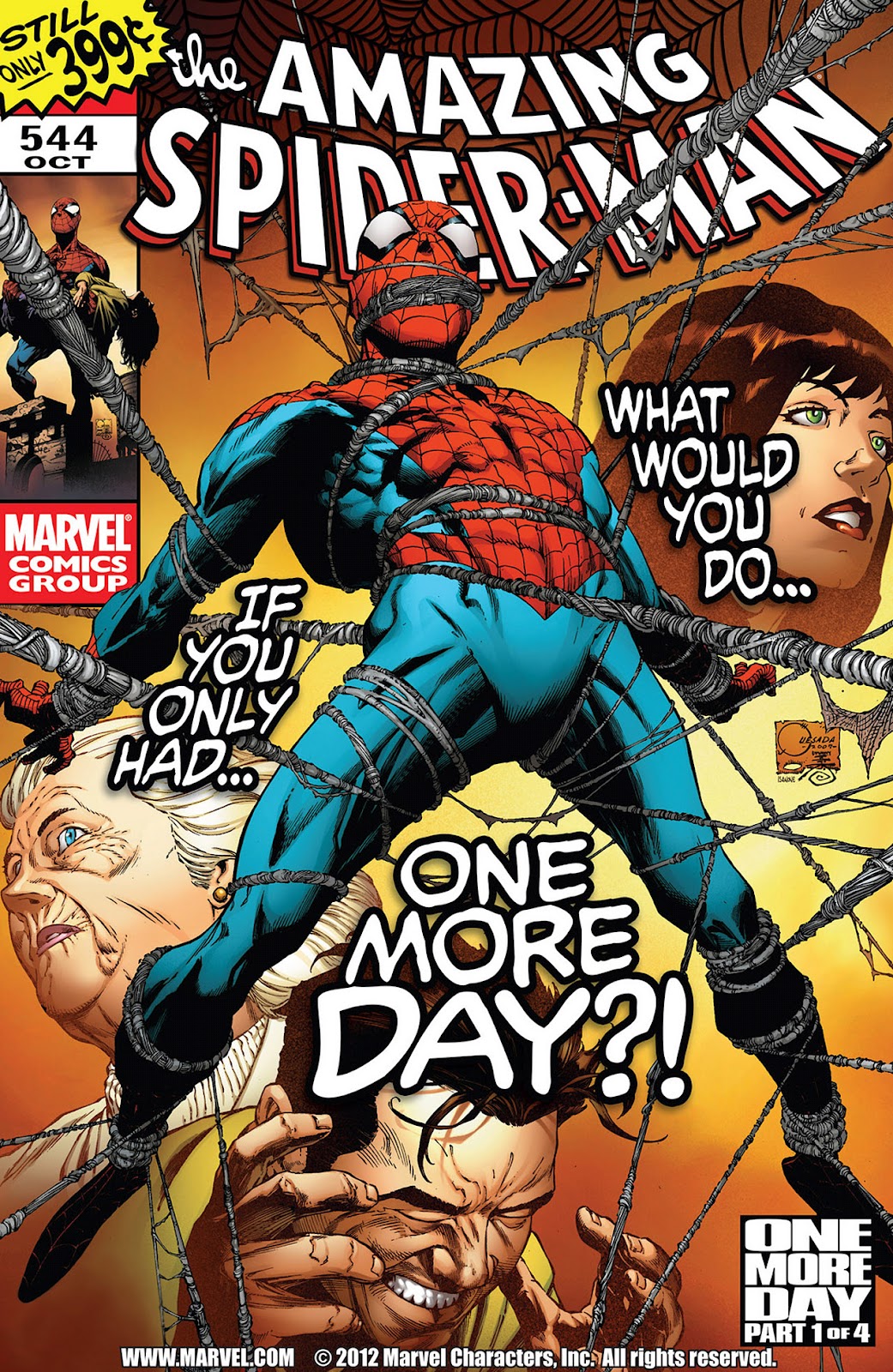
That is, of course, before One More Day. There was a fear at Marvel Editorial that Spidey had lost that relatable charm that was his hallmark. At the time of One More Day’s publication, Peter had a steady gig as the science teacher at his local high school, his marriage to Mary Jane was solid, and—with the exception of some magical mumbo jumbo that had invaded his life—Spidey almost had his life together. Which, of course, was not ok for a Spider-Man title. Tactfully, the editor-in-chief decided to force Peter to sell his marriage to the devil and undo all continuity that led up to that point—exactly the way I think anybody would handle that move given the circumstances.

See the source image
Credit where credit is due, this might be the last truly iconic Spidey cover.

Dripping sarcasm aside, it is safe to say that I’m not alone in my disdain for One More Day. The world hates One More Day. However, there is a large portion of Spider-Man fans that say its evil was a necessary one. Old Webhead had gotten too far from his roots, they argue, and wasn’t as relatable as he was in the good old days. Harkening back to those good old days, the Brand New Day initiative began, bringing in talent from the worlds of comic and film, complete with it’s own ‘manifesto’ of all their philosophies on how Spider-Man could never get so far from his roots ever again.


Here’s a shot of my Spider-Man manifesto reprinted in the back of the TPB for Brand New Day. It goes on for pages, this is just an idea of what it looks like.

This was my reentry to the title, and when I first read this manifesto, I loved it. New villains? Keeping to Spider-Man’s roots? An official statement from the Marvel bullpen that Spider-Man 2 is the greatest Spider-Man movie? What more could a guy ask for? Under the shepherding of Dan Slott, breakout star of Brand New Day, Spidey found himself fighting evil of all shapes and sizes, just like the good old days, for the next decade. Even as I describe it to you, it doesn’t sound like such a bad idea in concept.

But then something happened. Me and that aforementioned blue-eyed wonder? Wedded bliss. Exams? I took my last one this year. There is a real sense that young adulthood is behind me now, and I look to the future with more hopes and dreams than even the luckiest man could hope will all come true. Those high school good old days are behind me, and that’s alright. That’s how growing up works. But when I open up the latest issue of ASM, Peter Parker is still bumming around with his same room mates, still single, and still bumming from job to job just like he was when I opened my first issue of ASM as a boy. There is a real sense that I’ve outgrown my childhood hero. Which is alright. Not every story needs to appeal to every person. I still love Spidey, and still ravenously leap for ASM whenever I get the pocket change to do so (which means I’m about thirty issues behind, but I digress.) However, the reason I do feel inclined to protest in such an article as this one is that as whispers circulate that Spidey’s Brand New Day is coming to a close, the movement’s defenders argue that the initiative really was a success, and that it really did make Spider-Man more relatable. This just isn’t true.

See the source image
The milestones in Spidey’s life were the same as the milestones in his reader’s lives.

There is a real sense in which Peter Parker has been robbed of his right as a person—fictional or otherwise—to grow up. By keeping Spidey in a world where he is not allowed according to your own manifesto to change too much, you have turned Peter Parker into a sort of Peter Pan who will never grow up. This is done in the name of keeping the web slinger relatable, but what Marvel can’t seem to recognize is that while Spider-Man can play Peter Pan in his eternal Brand New Day for as long as he wants, aping his good old days ad nauseum, literally every one of his readers is still growing up. Every one of us is still changing, growing, and aging. But Spider-Man, trying to keep lightning in the bottle, is not. To put it another way, Spider-Man is in a fundamentally unnatural state that none of his readers can participate in and thus cannot find relatable. Spider-Man is no longer a guy just like me. He is a guy just like he used to be back in the good old days of the early sixties.

As mentioned, there seems to be a buzz around the new ASM title that things might go back to the way that they were before One More Day, and as much as I’ve enjoyed the stories that have come since that fateful event, I can’t help but say that it’s definitely needed. If Marvel wants Spider-Man to be the everyman that we all can relate to, he needs to be subject to one of the only things that is true for each and every member of his audience: change. This is what drew readers to the character in the first place: to see someone like us with powers beyond our wildest imagination ride the roller coaster that we call life with us. Rather than locking Spidey in a state of eternal youth, constantly reflecting on the good old days of the title, the main title needs to be willing to let Spider-Man experience life as his audience does. Failure to do so doesn’t make him more relatable, but rather locks him away as a Peter Pan in some Neverland none of us can get to. And, as I said earlier, even Pan recognizes that there is something wrong with someone who cannot grow up.

See the source image
Ending on a Bagley. Cuz I like Bagley.

The line between comics as an art and as a hobby is blurry at best, and nonexistent at worst, and nowhere is this more evident than when you are sent down an insane and somewhat madness-inducing rabbit hole. 

I am emerging from just such a rabbit hole.

Captain America: Living Legend wasn’t much more than a cash-in on the hype of the Captain America: Winter Soldier film before it was released: a quick four-issue series about Cap fighting techno organic Russians. Nothing was wrong with the story, there just wasn’t much to it. The draw of Living Legend was the gritty and realistic art by Adi Granov, a draw that has attracted me to the series more than once and caused me to collect the whole series in individual issues.

I was looking at some pages and covers that were rejected from the series just recently. They differ from the official published pages in only one way. Guess what way (here’s a hint: it might have something to do with a M1918 Browing Automatic Rifle.)

Rejected
Final

asdf

This cover was altered in the final to have Cap holding a flag rather than a gun.

This wasn’t the only page where this change was made: throughout Living Legend, Granov systematically removed Cap’s BAR, begging the question: should the super soldier not carry a gun? Does Marvel not want him to?

The following will be a brief history of Cap and his guns, and a personal verdict as to wether or not the super soldier should wield one.

In the Golden Age days, Cap—like all pulp heroes—wielded his gun proudly. Captain America, created before America’s official military involvement began, was created for one purpose: to kill Hitler and his followers. Not to take them prisoner, nor to convert them from their evil ways. Captain America was a soldier, and in 1942, everyone knew it.

Pasted Graphic 1.tiff
USA Comics 12 1944

When Cap first hit the screen, the character was radically reimagined, but the story regarding guns remained much the same. Pictured below, you can see a poster of Captain America serials from the famed serial studio ‘Republic,’ proudly wielding a pistol (albeit, in a mis-colored uniform.)

“What’s with the Red, Cap? You some kinda commie?”

After the war, Captain America lost popularity with the public. Marvel—then Timely—tried out some comics where Captain America was a ‘Commie Smasher,’ but these were resoundingly unpopular and the character was forgotten about til Stan Lee resurrected him in Avengers #4 in the early 1960s. This brought Captain America back into the mainstream of Marvel heroes and triumphantly welcomed him into the Silver Age of comics.

Why can I see his arm through his Shield? Can’t unsee it now.

Captain America became a mainstay Avenger and regained much of the popularity he had lost when the Golden Age ended, and this popularity followed him into the Bronze Age and early Modern Age. During these periods, however, Captain America rarely—if ever—used a gun. A major part of this is due to the fact that the Comics Code during the Silver Age prohibited this sort of violence, and the shield-throwing form of combat popularized during this period was popular enough to continue on to the Modern Age. The other part of this was due to the dislike certain members of Marvel staff had for Captain America—paragon of virtue—wielding a firearm. In an interview attached to the trade paperback of Captain America: White, Jeph Loeb made the following statement about Cap’s gun:

“He [carried a gun] in some of those Golden Age comics. Present day? It’s a useful thing to get people to talk about the book. Should he? Meh. He’s got the coolest weapon in the world–the shield” (Loeb and Sale, 2016.)

Tim Sale, the artist for the book, in the same interview stated that he would “have no interest at all in comic heroes who shoot people” (Loeb and Sale, 2016.)

Some fans felt similarly, with Tim Posada in his essay ‘Fetishizing Captain America’s Sidearm’ argued that the gun “revealed a more vulnerable figure whose idealism was now dirtied by reality” (Posanda, 2019.) Captain America during this period used guns infrequently at best, though this isn’t to say he never used them.

Gotten yourself into another clickbait article, that’s what you’ve done.
Cap, Buck and the boys packing heat and looking darn good doing it.

When Marvel’s Ultimates titles launched, creating a modern and  edgier Marvel universe, a modern and edgier Captain America followed. This Captain America made gun toting legendary, most notably in my favorite full-page splash featuring the star-spangled Avenger ever, as featured below.

Heck yes.

Ultimate Captain America was written much less like Superman and much more like Rooster Cogburn, and his gun usage followed suit with the hero featured on covers wielding big-butt assault rifles, as you can see in the first issue of the character’s limited series.

The strengths of Ultimates, in many cases, informed decisions made in the mainstream Marvel Universe, and so it should be no surprise that when Captain America was killed in the late 2000s (and he stayed dead forever, just like every other comic book character that isn’t Uncle Ben) and Bucky took over the role, Bucky was depicted wielding a handgun. Acclaimed comic artist Alex Ross, creator of the Bucky Cap costume, said he was calling back to the original Captain America serials with the inclusion of the gun, and this can be seen in the similarity between the two weapons.

Alex, you’re a legend.

In an interview with the artist team in charge of the title at the time, John Berman—writing for ABC News—asked if the inclusion of the gun served to “taint” the Captain America character. The team justified the decision that “Steve Rogers carried plenty of guns in the war. He never enjoyed using a gun, or a flame-thrower, or a grenade, but he had no real aversion to them either” (Berman, 2008.)

“But… but guns.”
New Avengers #53

With the praised adoption of so many Ultimates elements into the mainstream Marvel Universe underway, it should come as no surprise that Marvel would carry even more Ultimates elements into their newest film endeavor: the Marvel Cinematic Universe. For many audiences, these characters have become the definitive takes, and I confess when I read Captain America dialogue on the page, it is Chris Evans’ voice I hear in my head. This Captain America seems to have a greater affinity towards guns than his mainstream Marvel Universe counterpart, but far less affinity than his Ultimate Universe counterpart. More than any version perhaps, this Captain America embodied the statements made by the Marvel art team that Cap “didn’t like guns” but also “had no real aversion to them either.”

Cap and the bois, pulling a tyranny bust (1944, colorized)
Captain America: The First Avenger, 2011

In Captain America: The First Avenger, Captain America’s first MCU appearance, Cap wields multiple firearms over the course of the film (Captain America, 2011.) When he rescues Bucky towards the end of the second act, Captain America wields a machine gun, and for the remainder of the movie he wields a handgun which sits in a holster on his belt.

The next time we meet the character is in the Avengers, where his costume has been redesigned for the modern day, ditching the holster—although this may be a development late in the game based on some action figures released in conjunction with the film.

My Avengers 3 3/4 ” figure with a sculpted gun and holster, which the costume on-screen did not include, suggesting a late-in-the-game decision to ditch the gun.

That being said, the character did use a firearm during the assault on the SHIELD Helicarrier about midway through the film. During this sequence, Captain America is caught by surprise without his shield, and picks up an assault rifle from a fallen enemy to lay down cover fire so Iron Man can restart the Helicarier engines (Avengers, 2012.)

“Call your hits, bruh.”
Avengers, 2012

After this, however, Captain America becomes much less trigger-happy. This is the last time Cap uses a gun in the Marvel Cinematic Universe, with Winter Soldier being the first movie featuring Captain America in which he does not use a firearm for the entirety of the film’s runtime. And this, brings us to Living Legend, which came out that same year. With all this precedent, the creative team felt that they would be well justified in having Captain America tote a BAR during the World War II portion of the book. However, the final copy of the book features grenades hanging from Cap’s belt, a shield that can take the head off a panzer, but no BAR in sight (Diggle and Granov, 2014.)

Yeah… anyone hit by that is dead.
Captain America: Living Legend #1

Since Living Legend, Cap’s confused gun-toting legacy has continued. During Johnathan Hickman’s Avengers: Shards of Infinity, Cap wonders if the world would be a better place if all guns were rounded up and destroyed.

Kinda with Falcon on this one, Steve.
Avengers: Shards of Infinity #6 (Image Courtesy of Bounding Into Comics)

During Immonen and Fraction’s Fear Itself, however, Cap is shown wielding a weapon once more as he starts a militia in a post-apocalyptic ruin.

“You won’t be judged, but you probably will be dead.”
Fear Itself, (Image Courtesy of Bleeding Cool)

This shows that Marvel’s current stance towards Captain America’s gun usage is ambivalent at best.

This likely has something to do with Captain America’s inherently political nature. For a man wearing a flag who showed up just to “sock ole Adolph on the jaw,” one cannot expect anything else. Thus, people who feel strongly towards America’s position on gun control, viewing Cap as a symbol of America’s best qualities, are going to instinctively have Captain America take their stance on the issue. However, I feel that this instinct must be resisted, and here we get to the opinion portion of this essay.

With the exception of perhaps The New Deal, I can’t say I’m fond of the ‘Cap as an ideal’ style of story. To me, Cap is a person, and his stances on issues are rooted in his own experiences and morals. To me, Cap is a soldier, and for him to have negative feelings towards a soldier’s arsenal rubs me as strange to say the least, just as it would be strange for Batman to have positive feelings towards such an arsenal.

I understand the argument that Cap doesn’t need a gun, and I tend to agree with it. In Living Legend, as I mentioned prior, his shield is shown to decapitate a panzer in one throw (Diggle and Granov, 2014.) It makes sense that Cap can kill whoever he needs to with his shield. It also makes sense to say that the shield is most effective using both hands, thus ruling out the possibility of a sidearm. But all that said, I love to see Cap with a firearm.

Whatever your position on the owning of firearms by personal individuals, as an agent of SHIELD Cap is certainly entitled to one as much as Black Widow or Agent 13 are. Additionally, Cap is a soldier first and foremost, and I prefer it when his weaponry reflects this fact.

Cap and his soldier friends parachute into battle, guns blazing.
(All Winners Squad Band of heroes #2, image Courtesy of My Comic Shop.com)

A secondary—and far more tertiary reason—for advocating for Cap’s wielding of firearms is that of simple nostalgia. As a younger fan, nearly every Captain America figure I owned carried a firearm. Even my Bucky figure wielded twin tommy guns complete with drum mags. My attraction to Cap was as a costumed hero from World War II: a pulp hero before I even knew what a pulp hero was. My bedroom games consisted of Cap toting a machine gun on a desperate hunt for HYDRA, narrowly avoiding capture and experimentation by Baron Zemo. I like Cap with guns similarly to how someone who grew up around Cap from the Silver Age likely dislikes Cap with guns: it’s what I’m used to and what gives me them childhood fuzzies. (Gun’s givin’ ya the fuzzies. Huh.)

Cap and Buck on a backyard hunt for Ratzis

A third and final reason is that the firearm is just another way for Cap to be rooted in who he really is: a man out of time. To many modern readers familiar with characters like Batman, Superman, and Spider-Man who never take a life and certainly never arm up for the purposes of doing so, Cap taking a gun and killing his enemies—regardless of how abhorrent he may or may not find the deed—rubs readers the wrong way. But for Cap, a man from the mid-20th century where the only way to stop an evil man was by force, he realizes that this is the way he did it with the U.S. Army in World War II, and it must be the way he does it with SHIELD in modern day. Cap using a gun may seem out of place to a modern audience, but then, most of who Captain America is seems out of place too.

Tha man out of time, from his own time.
(Image source unknown)

In conclusion, Captain America has had a long and varied history with firearms, wielding them somewhat nonchalantly in the Golden Age, abandoning them in the Silver Age, and now seeming to wrestle with them here in the Modern Age. While I acknowledge I am likely in the minority, I’ve always liked Cap with his gun, as it fits his role as a soldier, is true to my childhood conceptions of the character, and contributes to his role as Marvel’s very own Man out of Time.

Works Cited

Avengers. Directed by Joss Whedon, performances by Robert Downey Jr., Chris Evans, Chris Hemsworth, Mark Rufallo, Scarlet Johanson, Jeremy Remmer and Samuel Jackson, Marvel Studios, 2012.

Berman, John. Interview with Michael Milberger and Olivia Brock. ABC News, 2008.

Captain America: First Avenger. Directed by Joe Johnston, performances by Chris Evans, Sebastian Stan, Halie Attwell, Tommy Lee Jones, and Hugo Weaving, Marvel Studios, 2011.

Diggle, Andy. Granov, Adi. Alessio, Augustin. Captain America: Living Legend. New York, Marvel Comics, 2014.

Loeb, Jeph. Sale, Tim. Captain America: White. New York, Marvel Comics, 2016.

Posada, Tim. “Fetishizing Captain America’s sidearm: iconography, exceptionality, and the politics of representing guns.” Nature.com

All images and references to other works belong to their respective owners and are used for educational purposes only.

Think back, dear reader, of the headlines of the past few months. In the past few months, people have accused the police of brutality, our medical officials of malicious intent, and the leaders of the most powerful nation on earth of moral ineptitude. I don’t bring any of these claims up to give my personal opinions on them. I bring them up to prove one simple point: Americans don’t trust anyone’s power, not even their own.

You could say this idea tracks back to our very founding, but since Watergate–a scandal where the most powerful man in the world ripped off his own citizens for his personal gain–I feel that Americans have dialed this up to an eleven. Scandal, arrogance, and abuse from people of power to people who have none has become commonplace. It’s expected, normalized, and downright boring. Absolute power corrupts absolutely, right?

In that case, there should be nothing more unusual than a man who had power and didn’t do any of those things: a man “who could be anything and chose to be good,” right? Judging by the tiny turnout to my first annual ‘Superman Day’ party, I’m going to have to say no.

From memes, critics, and friends, I’ve heard the Man of Tomorrow called many things, but none more than ‘boring.’ Because of his powers, he’s boring, Because of his character, he’s boring. Even DC fans seem to only want to see Supes get splattered in a fistfight with Batman. But, when pressed, some of these individuals cannot think of one Superman cartoon, comic, or movie that they’ve seen. These claims speak less to public opinion of the character then, but to a negative public opinion on the character’s relevance. Superman is not watched because Superman, now over seventy-five years old, is no longer relevant. At least, that’s what they think. It’s what I used to think too.

In the following essay, I want to challenge this popular notion about a character I’ve come to dearly love. If you’ve tried Superman and he’s just not your cup of tea, then fine: this essay isn’t for you. However, if you haven’t tried Superman and the memes and sneers have put you off to this timeless character as they once put me off to him, I would encourage you to read on as I deal with the relevance of The Man of Tomorrow.

Too Powerful to be Relevant

Even when I first became a frequent reader of comics, you wouldn’t catch me dead with a Superman comic, and that was for two main reasons that seem common amongst the characters’ detractors: he is way too powerful and he is way too good. 

First, I’d like to look at the character’s powers. Superman, on his best of days, can bench 200 quintillion tons with one hand, turn back time, and single handedly create an eclipse. These best of days, however, seem to have created the notion that there is no problem Superman can’t solve without using one of his plethora of Kryptonian abilities. This isn’t true for fundamental reasons. If Superman were a villain, his powers would allow him to do whatever he needed to, but as a hero they’re not that simple. Superman, due to the sense of personal responsibility he learned from his adoptive parents, only uses his powers in certain ways. This is what makes his conflicts with his archnemesis, Lex Luthor, so interesting: oftentimes the story ends with Supes hovering outside Lex’s window growling “I know what you did” to which Lex responds something to the effect of “and you can’t prove it and you won’t do anything illegal which means I’m safe.” And he’s right. Superman never supersedes the law–it’s against his moral code–and so his powers are limited to him using them by the book.

This doesn’t mean, however, that the Man of Steel can’t get into a good fisticuff now and again. People seem to forget that Superman’s powers are imaginary, and all it takes to beat the snot out of him is to imagine an equally powerful character, as many writers have. Doomsday, Zod, Brainiac and Darkseid are such characters, characters that can take on Superman with physical strength even on a bad day. Superman is powerful, yes, but so are his rogues. He defends an entire city, but his foes could wipe out an entire city by mere accident. This puts their battles on a cosmic level, but doesn’t make them devoid of conflict. Rather, the stakes of these world-ending battles increase the conflict given the number of players oftentimes involved. In the seminal Death of Superman, for instance, Superman fights against Doomsday, a villain easily as powerful as Superman intent on destroying him and the whole city with him. With Lois, Jimmy, the Justice League, Supergirl, and Supes’ own hide on the line, the tension doesn’t decrease, but increase (also, as a point to fist fights Superman can lose, please note that this story isn’t called Death of Superman for no reason.)

However, Superman is so much more than just Super. He is also, more than anything, a man.

Too Good to Be Relevant

More important than Superman’s powers is his character. People write off Superman as nothing more than a boy scout, but this is only a simplistic view of the character. Superman was created as a form of wish fulfillment: a classic Midwestern American with old school American values, given incredible strength to accomplish his goals: a paragon of virtue with great ability, much like Captain America or Optimus Prime. This, however, doesn’t mean that Superman is devoid of problems and conflicts anymore than Captain America or Optimus Prime are. Superman, because of his character and values, always knows what he wants, but makes mistakes trying to get it just as any hero does. In many ways, it increases the conflict when you have a character like Superman–whose character compels him to be a certain something–than it is for a morally ambiguous character who is willing to do anything for any reason, as a morally ambiguous character can take any number of paths to victory, whereas a moral character is limited to doing only ethical things to accomplish his goals. I mentioned earlier that Superman conflicts are defined by his refusal to use his powers unethically, but I didn’t examine how this extends to other areas of his character as well, specifically to his mission as a person. Superman is a person who could fly into the white house tomorrow and say ‘I’m in charge now for the good of humanity,’ and he’d be pretty darn good at it. Instead he spends his days putting out fires and catching kittens from trees. Superman’s character is a humble one: he doesn’t claim to know better than humanity, so as to be worthy of leading them, but rather he sees his role as that of a public servant, who is here to serve humanity. Whole stories, such as Red Son or Injustice, have been written to show what a well-meaning Superman who loses his humility and humanity could be, and the difference is striking because his humility is his defining trait.   

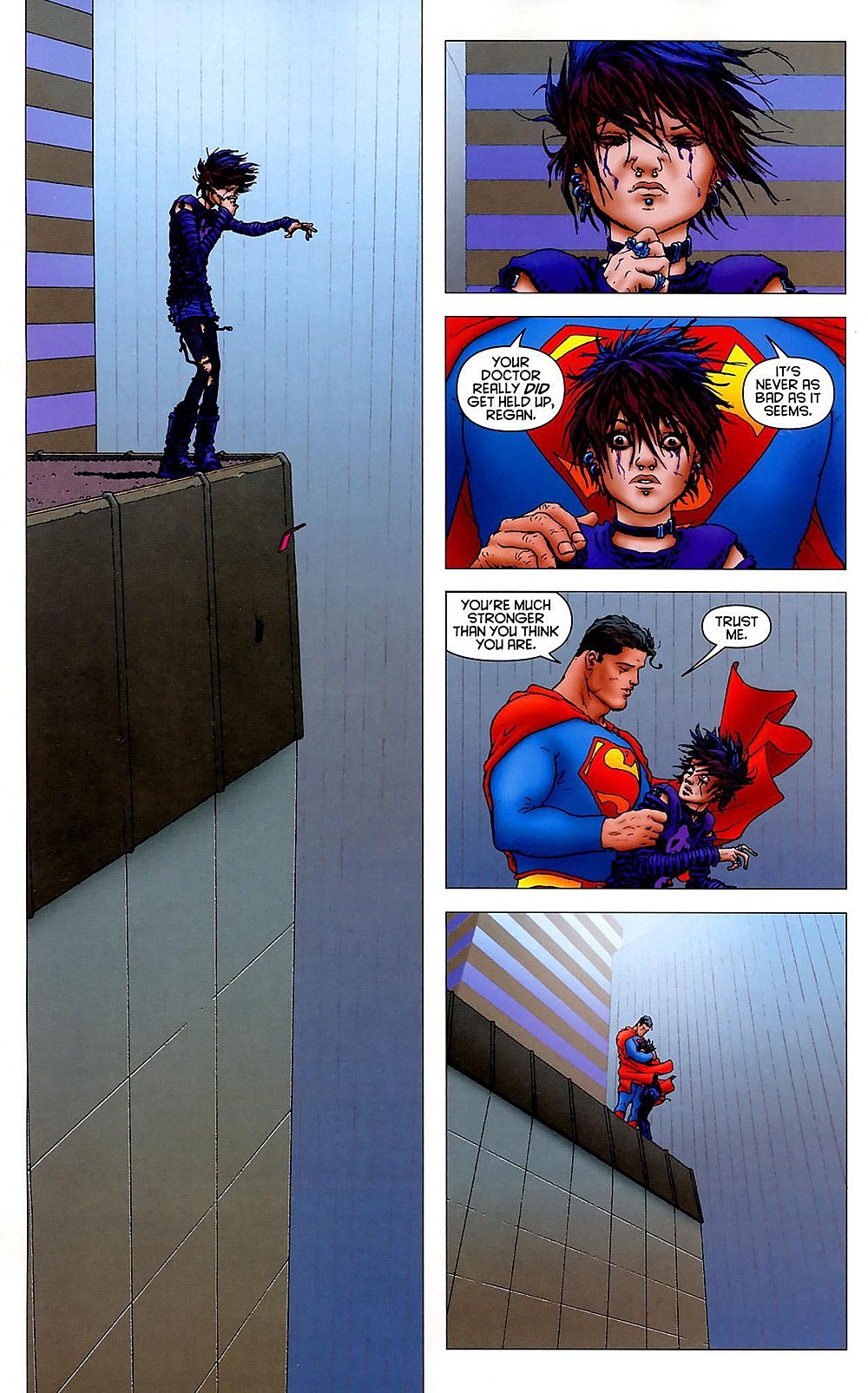
This moral fortitude in no way takes away from Superman’s character, or the drama of the stories he stars in. Rather, it is the core of those stories. Superman is the Man of Tomorrow, not the man of today. He is a figure of inspiration, not just for the characters in the DC universe, but for the audience as well. To illustrate this point, let me show you a scene from Allstar Superman by Grant Morrison and Frank Quietly.

If this scene doesn’t prove that Superman is as relevant as Captain America or any other superhero ever created, then it’s possible nothing will.

In conclusion, I’d argue that much of the dialogue about Superman is fueled by misconceptions and memes more than the actual writing behind a legendary character: a legendary character who deserves a try if you haven’t given one before. If you’re like me and enjoy classic heroes like Captain America or Spider-Man, but haven’t taken the time to try the classic that started it all, I hope I’ve encouraged you to give him a try. Superman is a character that has been important to many for over seventy five years, and it looks like there is no danger of that changing, certainly not if new fans continue to hop onto his Kryptonian bandwagon. After all, he’s not the man of yesterday. He’s the Man of Tomorrow.

Design a site like this with WordPress.com
Get started